
Standard Pallet Size for Shipping, Storage & Warehousing
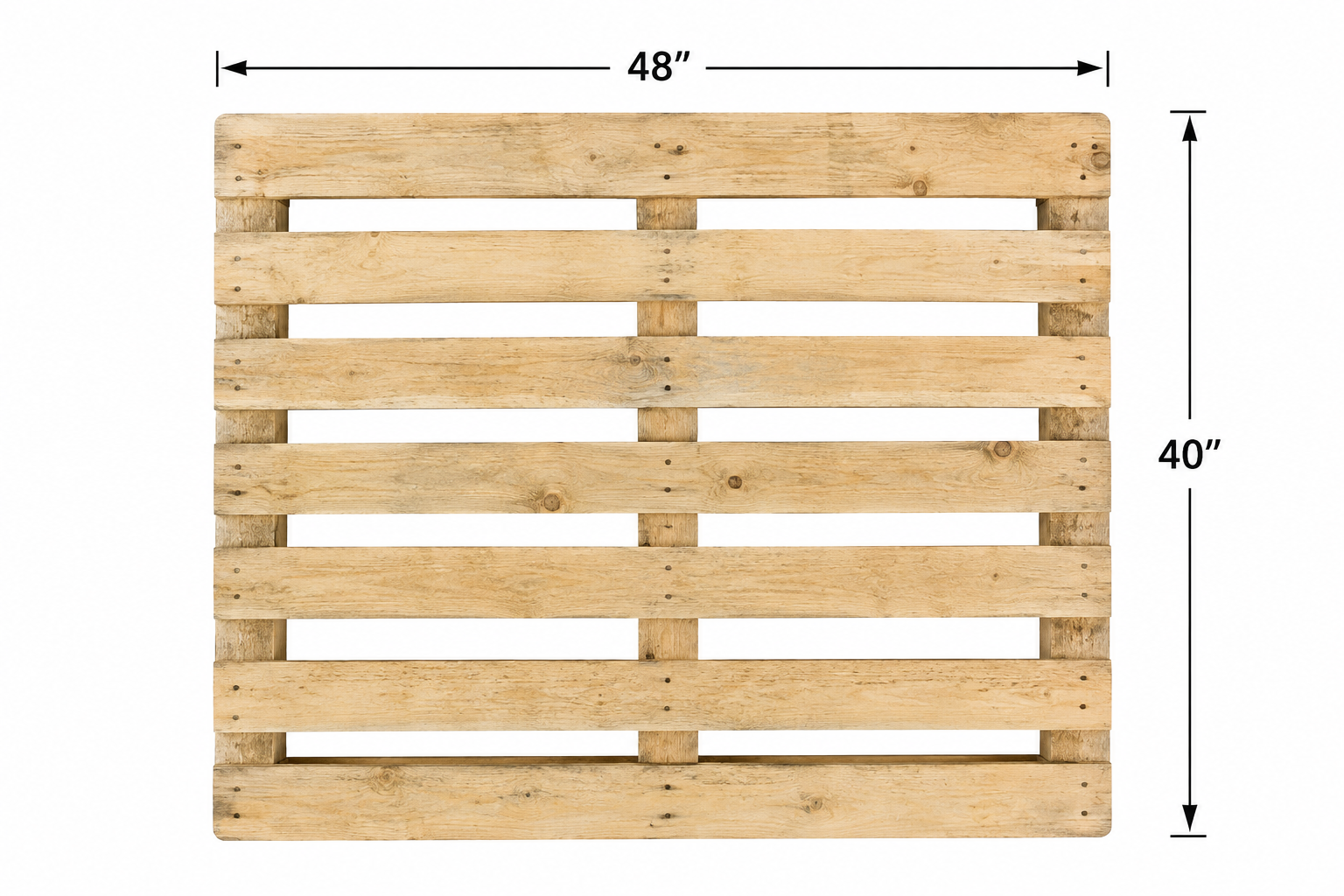
Standard pallet size is one of the first specifications businesses need to confirm before storing, transporting, or shipping products. In Canada and North America, the most common pallet footprint is 48 × 40 inches, but that doesn’t mean every pallet is built the same.
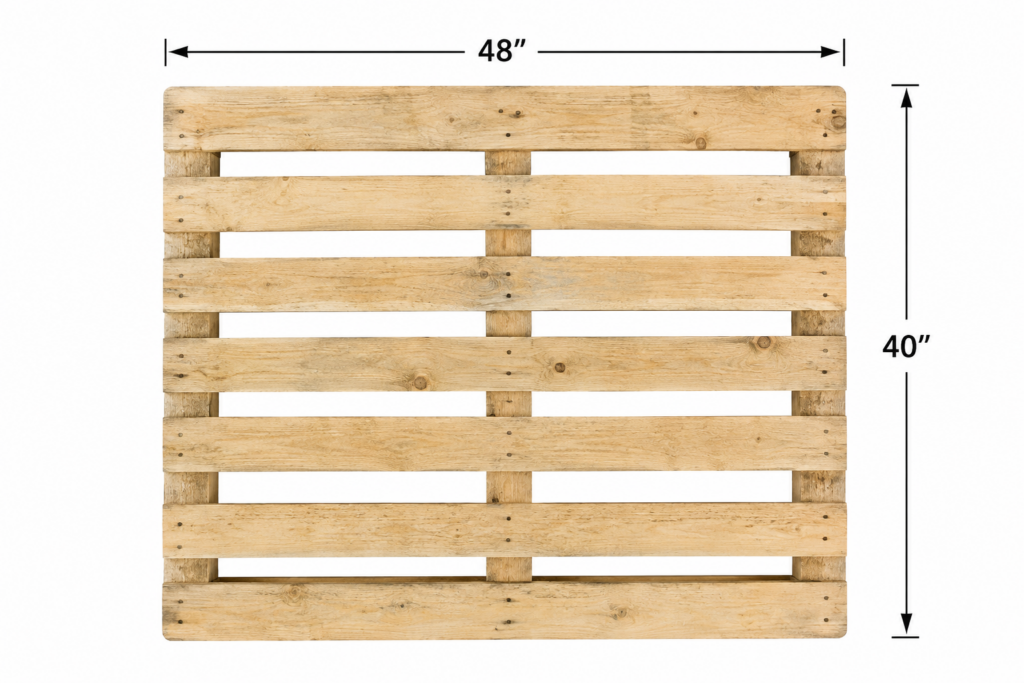
The right pallet depends on your product dimensions, handling equipment, storage system, and shipping requirements. This guide explains standard pallet dimensions, common measurements, industry applications, and how to choose the right pallet size for your operation.
Quick Answer: The most common standard pallet size in Canada and North America is 48 × 40 inches (1219 × 1016 mm). It is widely used across retail, manufacturing, warehousing, and distribution because it works efficiently with most forklifts, pallet racking systems, and transportation networks. However, other standard pallet sizes are often used for specific industries, products, and export requirements.
What Does “Standard Pallet Size” Actually Mean?
Although 48 × 40 inches is the most common standard pallet size used across Canada and North America, it isn’t the only pallet size used in business operations. Different industries rely on different pallet footprints depending on the products they handle, storage systems, and transportation requirements.
Think of the standard pallet size as the most widely adopted option, not a universal size that fits every application.
For example, grocery distribution centres, manufacturing plants, automotive suppliers, and chemical companies often use different standard pallet dimensions to improve handling efficiency and make better use of available warehouse and trailer space.
Expert Insight: A pallet’s footprint is only one part of the specification. Two pallets with the same standard pallet measurements can perform very differently depending on their construction, deck layout, entry type, lumber quality, and intended load.
Common Standard Pallet Sizes at a Glance
| Pallet Size | Metric Equivalent | Common Applications |
|---|---|---|
| 48 × 40 in | 1219 × 1016 mm | Retail, grocery, warehousing, general freight |
| 48 × 48 in | 1219 × 1219 mm | Drums, chemicals, bulk products |
| 48 × 45 in | 1219 × 1143 mm | Automotive manufacturing |
| 42 × 42 in | 1067 × 1067 mm | Beverage, paint and industrial products |
| 1200 × 800 mm (Euro Pallet) | 47.2 × 31.5 in | European shipping and export supply chains |
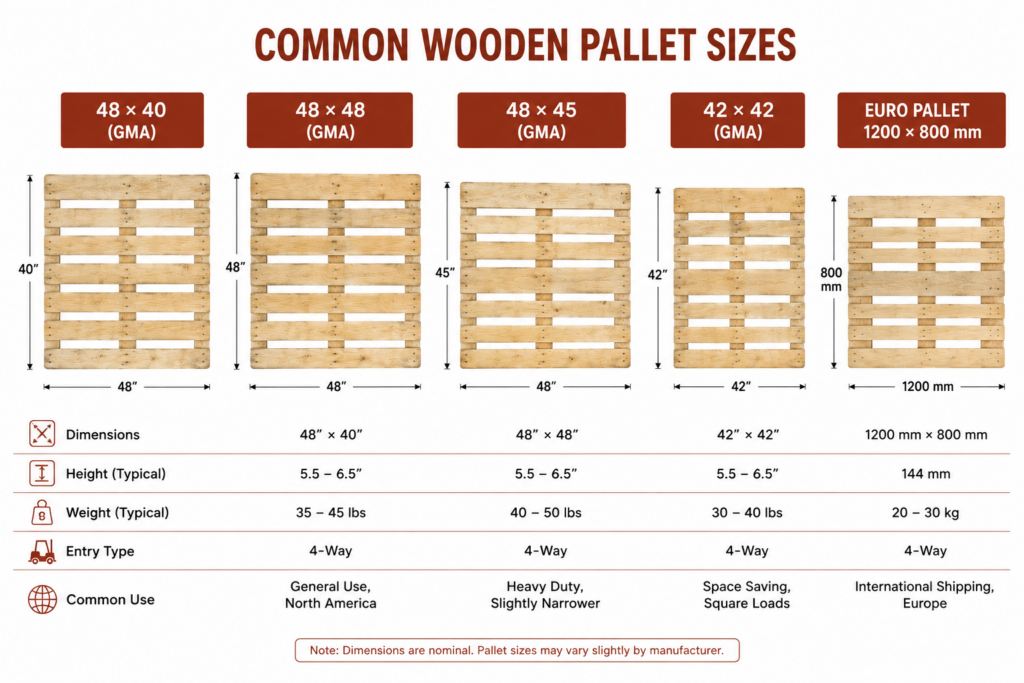
Key Takeaway: The 48 × 40-inch pallet remains the dominant standard pallet size across North America, but selecting the right pallet should always depend on your product dimensions, handling equipment, storage layout, and shipping destination.
How to Measure Standard Pallet Dimensions Correctly
Understanding the standard pallet size is helpful, but measuring a pallet correctly is just as important. Two pallets may share the same footprint while differing in height, deck construction, or entry design. Understanding these measurements helps ensure the pallet fits your products, warehouse equipment, and shipping requirements.
The Four Measurements That Matter
When measuring a standard wooden pallet, record these dimensions in the following order:
| Measurement | What to Measure | Why It Matters |
|---|---|---|
| Length | The longest side of the pallet. | Determines product support and trailer layout. |
| Width | The shorter side of the pallet. | Affects storage, racking, and stacking efficiency. |
| Overall Height | From the floor to the top deck surface. | Helps calculate loaded pallet height for transport and storage. |
| Fork Entry Openings | The clearance for forklifts and pallet jacks. | Ensures smooth handling and equipment compatibility. |
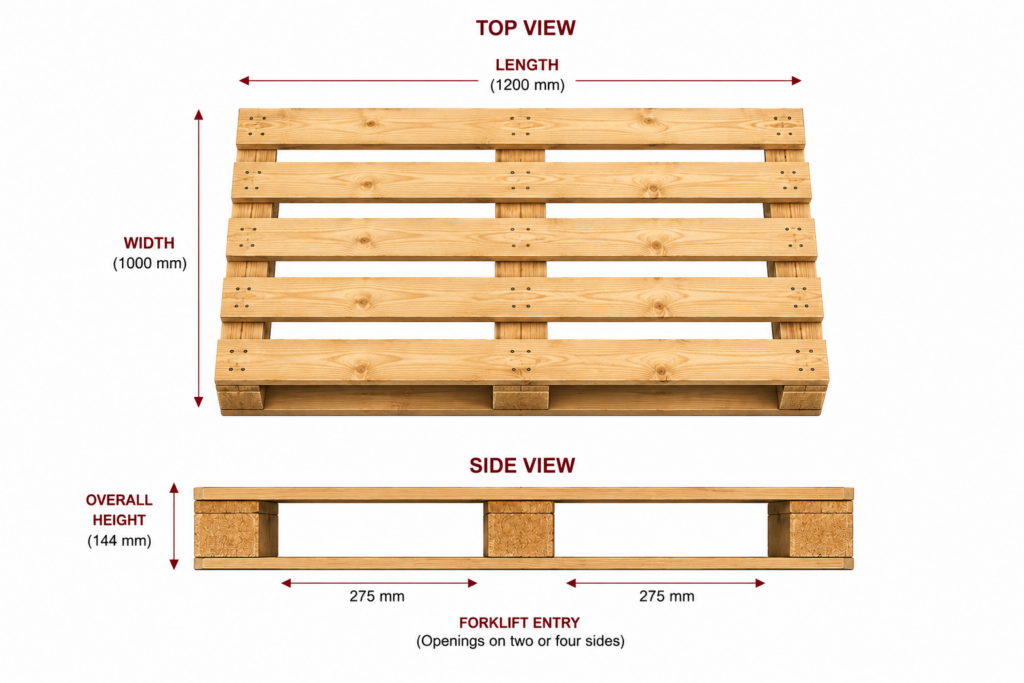
Quick Tip: Pallet dimensions are always written as Length × Width. A 48 × 40 pallet is different from a 40 × 48 pallet, even if the numbers are the same.
Standard Pallet Measurements in Inches and Millimetres
The most common standard pallet size used across Canada and North America measures:
| Measurement | Imperial | Metric |
|---|---|---|
| Length | 48 in | 1219 mm |
| Width | 40 in | 1016 mm |
| Typical Height* | Varies by construction | Varies by construction |
The height of a pallet is not standardized. It depends on factors such as lumber thickness, deck board design, support structure, and the type of pallet being manufactured.
Expert Insight: One of the most common buying mistakes is assuming every standard pallet size has the same height or load capacity. In reality, pallets with the same footprint can have different specifications depending on their intended application.
Why Height Is Measured Separately
When businesses search for standard pallet height dimensions, they’re often expecting one fixed number. In practice, pallet height varies because different industries require different designs.
Height can be influenced by:
- Stringer or block pallet construction.
- Number and thickness of deck boards.
- Heavy-duty or lightweight pallet design.
- Repair history for recycled wooden pallets.
- Specific customer or industry requirements.
This is why pallet suppliers typically confirm the complete specification instead of relying only on the footprint.
Key Takeaway: The 48 × 40-inch footprint is the industry benchmark, but a complete pallet specification should always include its length, width, height, entry type, and construction before making a purchasing decision.
Does the Standard Pallet Size Fit Your Warehouse and Shipping Requirements?
Knowing the standard pallet size is only the first step. Before ordering pallets, it’s important to confirm that the dimensions work with your warehouse layout, handling equipment, and transportation method. A pallet that fits the product but not the racking or trailer can create unnecessary handling issues and wasted space.
Instead of focusing only on the pallet footprint, evaluate how the pallet will move through your entire supply chain.
Warehouse Compatibility Checklist
Before selecting a standard pallet size, confirm the following:
| Check | Why It Matters |
|---|---|
| Pallet racking dimensions | The pallet should sit securely on rack beams without excessive overhang. |
| Forklift and pallet jack access | Ensure the pallet entry design matches your handling equipment. |
| Storage layout | The pallet footprint should maximise warehouse space while allowing safe movement. |
| Loaded pallet height | Verify there is enough vertical clearance for storage and handling. |
| Product stability | Products should remain fully supported without excessive overhang. |
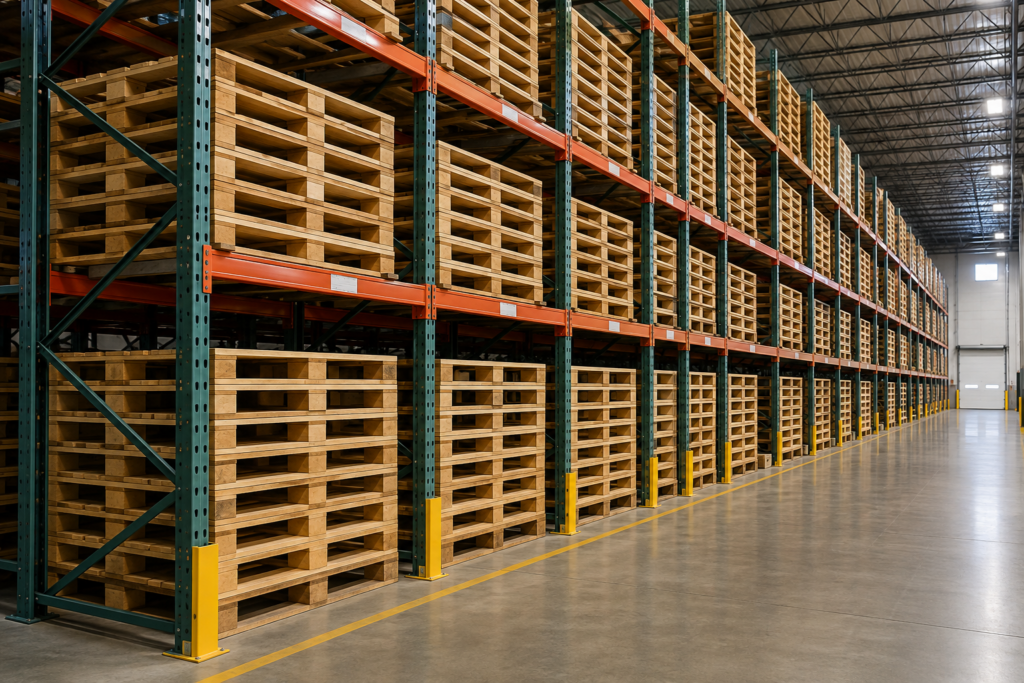
Expert Recommendation: A pallet that fits your warehouse safely is usually more valuable than simply choosing the most common standard pallet size. Always check your racking specifications before placing an order.
Standard Pallet Size for Shipping
The 48 × 40-inch standard pallet size is widely used because it works efficiently with many transportation systems across North America. However, successful shipping depends on more than the pallet footprint.
Before shipping, consider:
- Total loaded pallet height.
- Overall shipment weight.
- Trailer or shipping container dimensions.
- Load distribution across the pallet.
- Export requirements for heat-treated wooden pallets when shipping internationally.
Different carriers and freight providers may have their own size, weight, and stacking requirements, so it’s always worth confirming shipment specifications before dispatch.
Key Takeaway: The right standard pallet size should fit not only your products but also your warehouse, handling equipment, and transportation process. Looking at the complete logistics chain helps reduce damage, improve efficiency, and avoid costly adjustments later.
When a Standard Pallet Size Is Not the Best Fit
The most common standard pallet size is useful for many shipping and warehouse applications, but it should not be treated as the default for every product. The better choice is the size that supports the load efficiently and works with the equipment handling it.
A different pallet dimension may make more sense when:
- The product is significantly longer or wider than the pallet footprint.
- Excessive product overhang could create instability or damage.
- A warehouse has fixed racking or conveyor dimensions.
- The product requires a square or specialised footprint.
- The shipping configuration would leave substantial unused space.
- A customer or export market specifies a particular pallet dimension.
Standard vs. Custom: A Practical Decision
| Situation | Better starting point |
|---|---|
| General warehouse and retail freight | Standard pallet size |
| Product fits efficiently on 48 × 40 in | 48 × 40 pallet |
| Product has an unusual footprint | Custom pallet |
| Special machinery or handling system | Application-specific pallet |
| Specific customer dimensions required | Specified/custom size |
| European supply chain | Euro pallet dimensions |
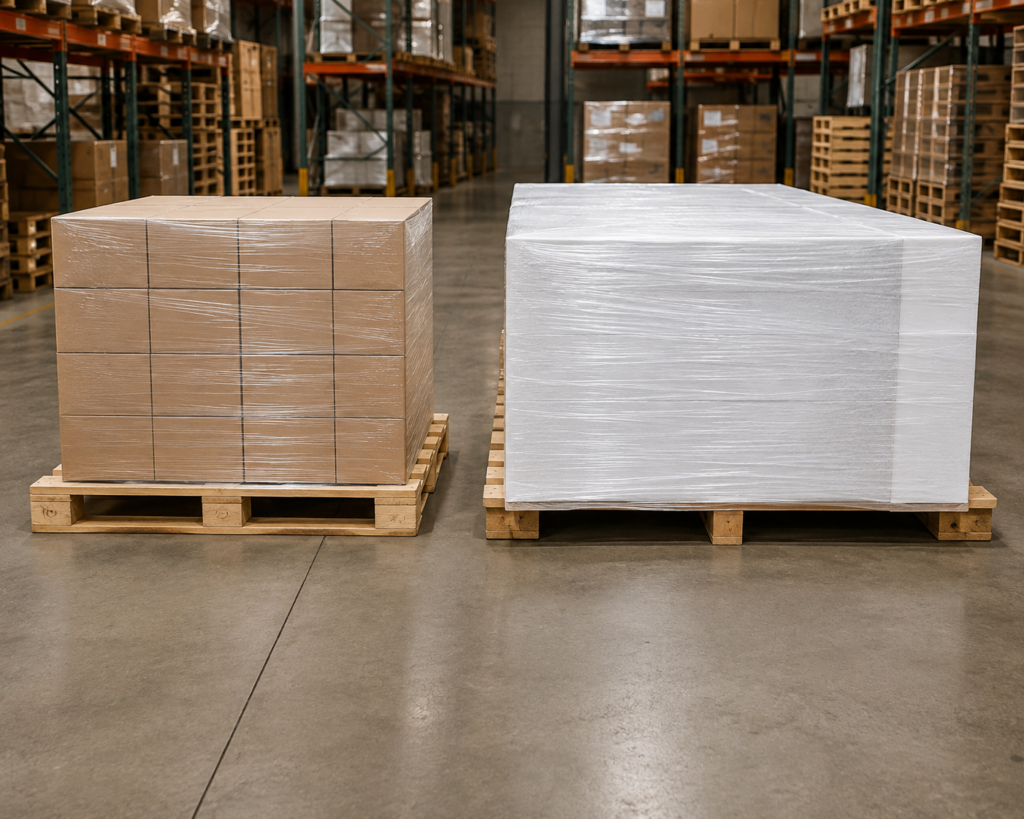
If your product does require a different footprint, custom pallets can be designed around the product dimensions, handling equipment, and intended application rather than forcing the load onto a standard platform.
Why 48 × 40 Inches Became So Widely Used
The popularity of the 48 × 40 format is not simply because it is called a standard. Its widespread adoption comes from compatibility.
The footprint works well across many warehousing, retail, manufacturing, and distribution environments, making it easier for businesses to move products between suppliers, warehouses, carriers, and customers without constantly changing pallet specifications.
Its widespread use also means many handling systems are already designed around the footprint, including:
- Forklifts and pallet jacks
- Pallet racking
- Distribution centres
- Retail supply chains
- General freight operations
Key Takeaway: The value of a common pallet footprint is system compatibility. A widely used size can move through more parts of a supply chain without requiring specialised handling or storage arrangements.
Common Pallet Sizes Compared by Application
There is no single standard pallet size that works for every supply chain. The right footprint depends on the product, industry, handling system, and destination. Comparing the most common formats makes the choice much easier.
| Pallet Size | Metric Size | Where It Commonly Fits |
|---|---|---|
| 48 × 40 in | 1219 × 1016 mm | General freight, retail, grocery, warehousing |
| 48 × 48 in | 1219 × 1219 mm | Drums, chemicals, bulky or square loads |
| 48 × 45 in | 1219 × 1143 mm | Automotive applications |
| 42 × 42 in | 1067 × 1067 mm | Paint, beverage and industrial products |
| 1200 × 800 mm | 47.2 × 31.5 in | European supply chains |
These dimensions describe the pallet footprint. Height, deck construction, entry configuration, and load capacity can vary within the same size category.
Common Mistake: Don’t compare pallets by footprint alone. A 48 × 40 pallet with a different deck design or support structure may have very different performance characteristics from another pallet with the same dimensions.
Standard Pallet Size: Inches, Millimetres and Feet
For purchasing and logistics teams, converting measurements between systems can prevent simple specification errors.
The common North American standard pallet size is:
48 × 40 inches
1219 × 1016 mm
4 × 3.33 feet
| Measurement | Inches | Millimetres | Feet |
|---|---|---|---|
| Length | 48 in | 1219 mm | 4 ft |
| Width | 40 in | 1016 mm | 3.33 ft |
When communicating pallet requirements to a supplier, use the exact unit and measurement order rather than simply saying “standard pallet.” This avoids confusion when a supplier works with multiple pallet sizes.
Expert Insight: If a quotation, purchase order, or customer specification calls for a particular pallet size, write the actual dimensions, for example, 48 × 40 inches, instead of relying on the word “standard.”
What to Confirm Before Ordering Pallets
Once you know the required footprint, confirm the specifications that can affect how the pallet performs. This prevents a situation where the dimensions are correct but the pallet is unsuitable for the actual load or handling environment.
| Specification | What to confirm |
|---|---|
| Pallet dimensions | Exact length × width |
| Overall height | Required clearance for storage and transport |
| Load requirement | Expected static, dynamic, or racking load |
| Entry type | Two-way or four-way forklift access |
| Deck construction | Board spacing and deck strength |
| Pallet condition | New, recycled, or repaired |
| Treatment requirements | Required treatment or certification for export |
| Handling system | Forklift, pallet jack, conveyor, or automated equipment |
A pallet specification should describe more than its footprint. Dimensions, construction, load requirements, and handling compatibility should all be confirmed before purchasing.
A Simple Way to Select the Right Pallet Size
Use this sequence when comparing pallet options:
1. Start with the product.
Measure the product footprint and determine its loaded weight.
2. Check the handling system.
Confirm forklift entry, pallet-jack access, racking, and any conveyor requirements.
3. Check transportation.
Consider trailer, container, carrier, and destination requirements.
4. Compare available pallet sizes.
Start with a commonly used size if it supports the load efficiently.
5. Consider a different footprint only when necessary.
If the product, equipment, or logistics system creates a limitation, an alternative or custom dimension may be more appropriate.
This approach keeps the decision based on actual operating requirements, rather than choosing a pallet simply because it is commonly available.A Simple Way to Select the Right Pallet Size
Standard Pallet Size Selection Checklist
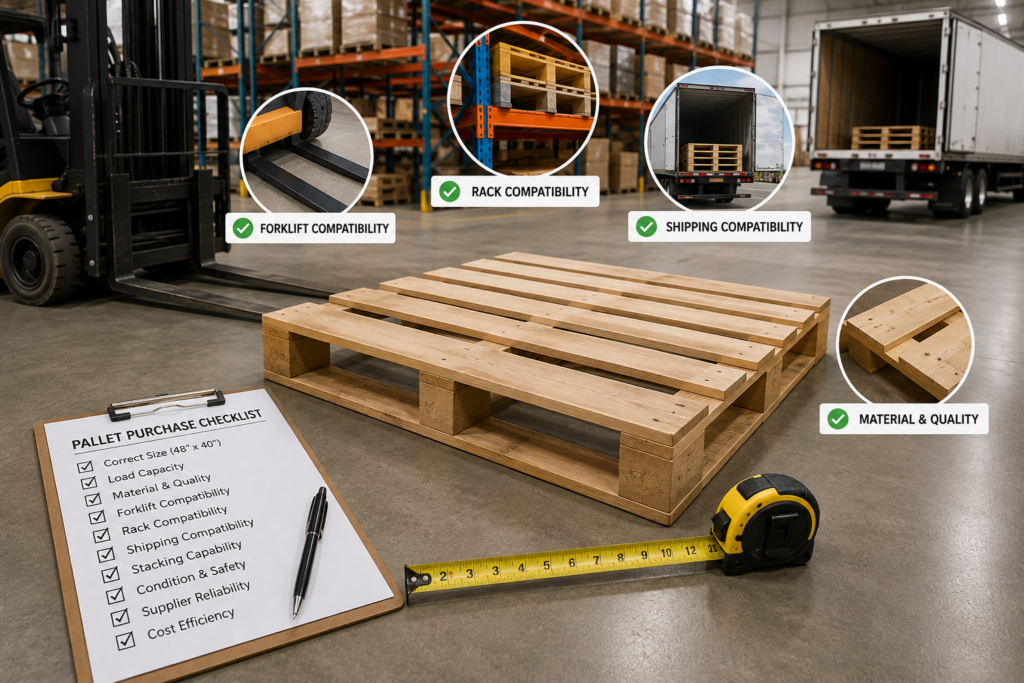
Before finalizing an order, verify:
- Product footprint measured
- Loaded weight confirmed
- Required pallet dimensions confirmed
- Pallet height checked
- Forklift or pallet-jack entry confirmed
- Racking compatibility verified
- Shipping requirements reviewed
- Export treatment requirements checked, if applicable
- New or recycled condition specified
- Customer requirements confirmed
When Export Requirements Affect Pallet Selection
If pallets are moving across international borders, physical dimensions are only part of the specification. Wood packaging material may also need to meet the destination country’s phytosanitary requirements.
For international shipments, ISPM 15 addresses the treatment and marking of wood packaging material, including wooden pallets. The requirement concerns how the wood is treated and identified; it does not establish one universal pallet dimension.
For that reason, confirm both:
- The required pallet dimensions for the shipment.
- Whether the destination requires ISPM 15-compliant pallets.
For Canadian exporters, requirements can vary by destination, so the applicable country’s import requirements should be verified before shipping.
Choosing the Right Pallet Starts With the Right Specification
The standard pallet size of 48 × 40 inches is a practical starting point for many North American shipping, storage, and distribution applications, but it is not automatically the right choice for every load.
Before ordering, confirm the pallet’s dimensions, height, construction, load requirements, handling method, storage system, and shipping destination. When a common size does not suit the product or operation, another established size or a custom pallet may be the better option.
Need help choosing the right pallet dimensions for your application? Contact West Coast Pallet Ltd. to discuss your requirements and available pallet options.